
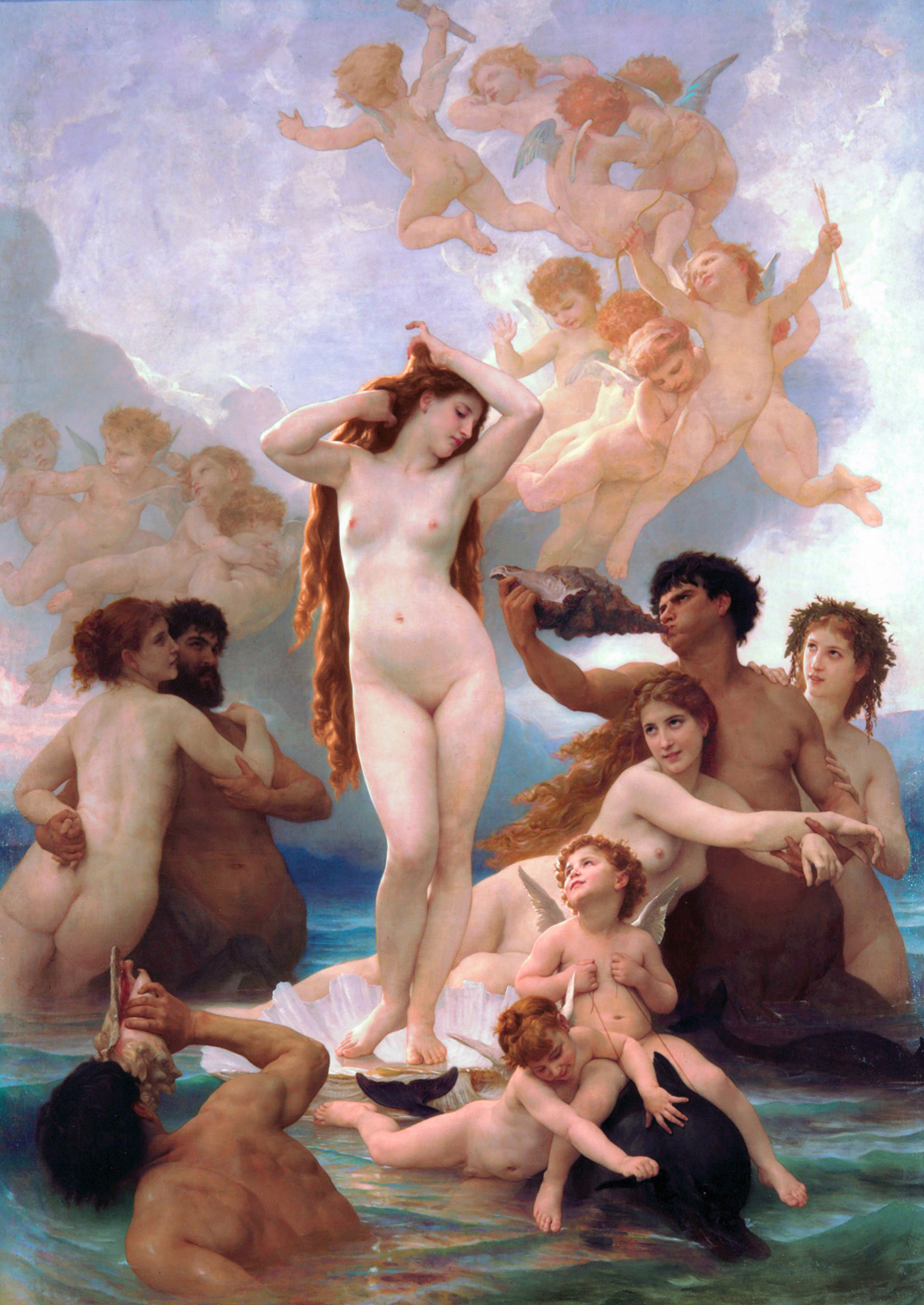
In Greek mythology, Aphrodite is the goddess of love, beauty and sexual passion. She was born when Uranus was castrated by his son Cronus, his severed genitals thrown into the ocean began to churn and foam about them. From the aphros (“sea foam”) arose Aphrodite, and the sea carried her to the Isle of Cyprus.
After her birth, Zeus feared that the gods would fight over Aphrodite’s hand in marriage so he married her off to Hephaestus, god of fire. She loved gaiety and glamour and was not at all pleased at being the wife of the smithy Hephaestus. He forged an embroidered girdle for her called Cestus, which had the power of inspiring love. Aphrodite loved and was loved by many gods and mortals. Among her mortal lovers, the most famous was Adonis. Some of her sons are Eros, Anteros, Humenaios and Aeneas. Her favorite birds were swans and doves, and the rose and myrtle were sacred to her.
Ancient mythology furnishes numerous instances in which Aphrodite punished those who neglected her worship or despised her power, as well as others in which she favoured and protected those who did homage to her and recognized her sway. Love and beauty are ideas essentially connected, and Aphrodite was therefore also the goddess of beauty and gracefulness. In these points she surpassed all other goddesses, and she received the prize of beauty from Paris; she had further the power of granting beauty and invincible charms to others.
Her festival is the Aphrodisiac which was celebrated in various centers of Greece and especially in Athens and Corinth. Her priestesses were not prostitutes but women who represented the goddess and sexual intercourse with them was considered just one of the methods of worship.
The most detailed information on Aphrodite may be found here: http://www.theoi.com/Olympios/Aphrodite.html
 the soulmate manifesto